LED Face Mask Colors: Which of 7 Modes to Use When
An overview of all 7 LumenLuxe LED mask modes, their wavelengths and what the available studies say about each light colour – including their limitations.

Choose the color of your LED mask by your skincare goal and skin type: red mode (630 nm) is most often used for mature skin and wrinkles, blue (460 nm) for oilier skin. Green, purple, yellow, cyan and white modes complete the choice. Evidence differs from color to color and is limited for some.
The cited studies tested other devices and wavelengths; their results are not results of the LumenLuxe mask. LumenLuxe has no clinical study of its own, and the LED mask is a cosmetic device, not a medical device.
How many colors does the LumenLuxe LED mask have and what do they mean?
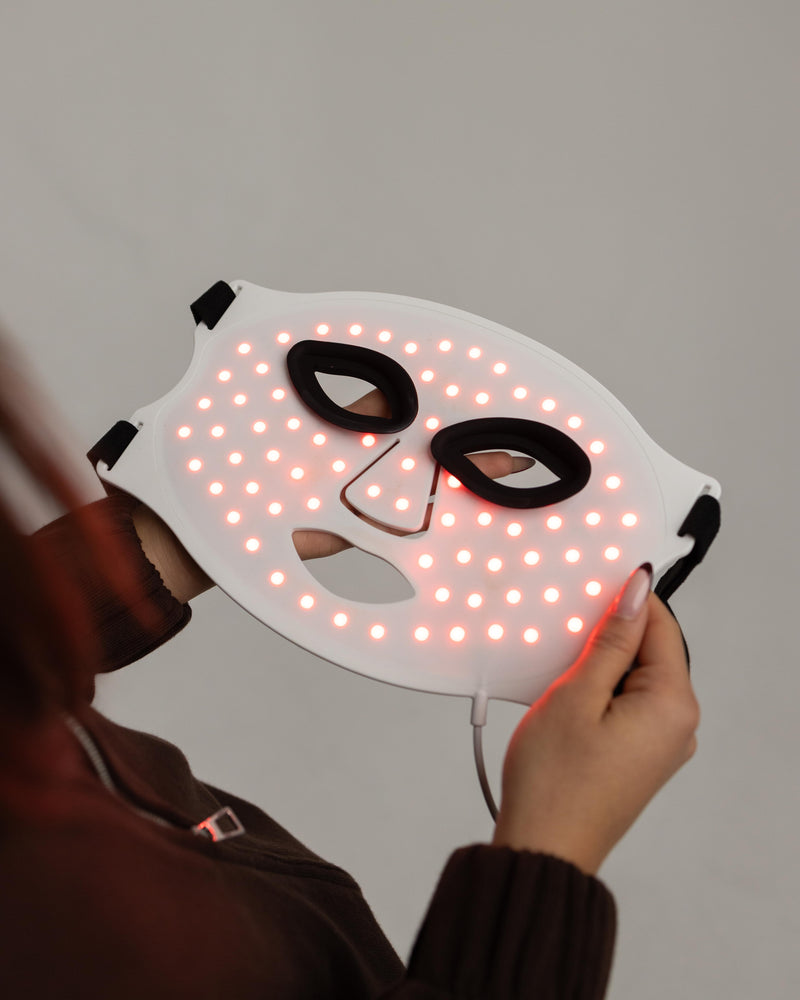
The LumenLuxe LED mask has 7 modes: three basic wavelengths and four combinations. Every mode uses 210 diodes and a session lasts 10 minutes.
| Mode | Wavelength | Most often used for |
|---|---|---|
| Red | 630 nm | Mature skin care, fine lines, texture |
| Blue | 460 nm | Oilier, less clear skin |
| Green | 520 nm | Uneven skin tone, dark spots |
| Purple | 630 + 460 nm | Combination of red and blue |
| Yellow | 630 + 520 nm | Combination of red and green |
| Cyan | 520 + 460 nm | Combination of green and blue |
| White | 630 + 520 + 460 nm | All three wavelengths at once |
The mask has no infrared (NIR) light. Available red-light studies often use other bands, so results cannot be transferred to every mode.
What do studies show about red light?
Most data exist for red light, but they involve other devices and wavelengths than our mask. In the laboratory and clinical study by Barolet et al. (2009) using 660 nm light, a skin model showed a 31 % increase in type I procollagen and an 18 % decrease in MMP-1; in the split-face part after 12 sessions, 87 % of participants had a lower wrinkle severity score in blinded assessment (PMID 19587693).
The cited studies tested other devices and wavelengths; their results are not results of the LumenLuxe mask.
A home mask with 630 nm red light was studied by Couturaud et al. (2023): 20 women used the mask for 12 minutes twice a week for 3 months, and improvement in wrinkle depth, firmness, dermal density and pores was assessed (PMID 37522497). The study had no control group and the authors were employees of the mask manufacturer, so take it with caution. The difference between red and blue light is explained in Red vs. blue LED light.
What about blue light at 460 nm?
For blue light our list of verified studies has no separate LED evidence, so we do not present it as a proven solution. The blue mode is commonly used in cosmetic care of oilier skin, and choosing it is more a matter of experience than firm data.
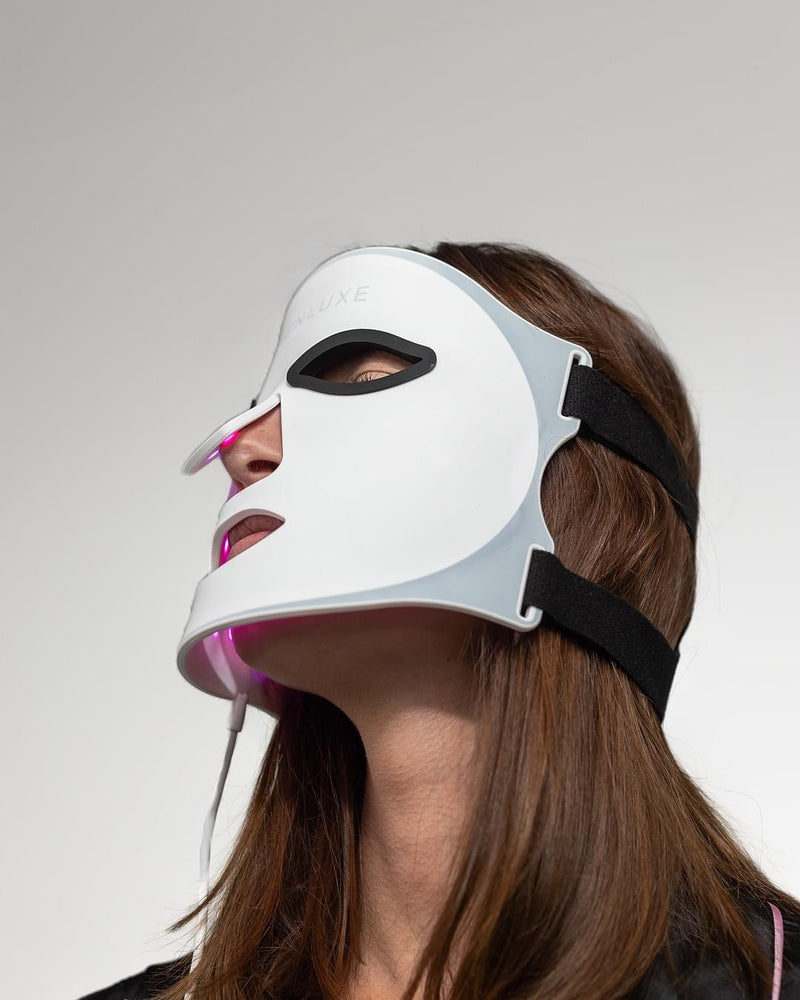
Caution is needed with blue light at 460 nm near the eyes. The mask is therefore used with eyes closed and with the protective shields included in the box.
Does green light help with dark spots and skin tone?
Evidence on green light is limited. The integrative (not systematic) review by Galache et al. (2024) summarized 9 studies, including laboratory and animal ones, and looked at the effect of photobiomodulation on tyrosinase at 630, 585/590 and 830/850 nm with doses of 1–20 J/cm² (PMID 38018017). The green 520 nm wavelength was not assessed.
We therefore see the green mode as a supporting one for hyperpigmentation and dark spots, not as a session with a proven result. More in Skin pigmentation and the LED mask.
Which color should I choose for my skin type?
Roughly, by what you want to support in your routine. This is not medical advice and individual skin response differs.
| Type / goal | Indicative choice | Note on evidence |
|---|---|---|
| Mature skin, fine lines | Red | Most studies, other devices |
| Oilier skin | Blue | No own evidence in our list |
| Uneven tone, dark spots | Green, yellow | Limited evidence |
| Sensitive skin | Cyan, lower intensity | Start gently, patch test on hand |
| You want simplicity | White | All three wavelengths at once |
With sensitive skin start at the lowest of 5 intensity levels and watch the response. More in LED mask and sensitive skin.
What is the light dose in one session?
At maximum intensity the output is 20 mW/cm², which is about 12 J/cm² in 10 minutes. This is the device manufacturer's figure. The study by Huang et al. (2009) describes a biphasic dose response in photobiomodulation, so more does not have to mean better (PMID 20011653).
How often should I change colors and in what order?
Usually 3–5 times a week for 10 minutes, one color per session. The pace of change is individual. Let your skin get used to one mode and try new ones gradually.
Who should not use an LED mask?
Do not use the mask during pregnancy, with light-sensitive epilepsy, an active skin disease or infection in the area of use, retinal disease or with photosensitizing medication (e.g. isotretinoin, some antibiotics). Use photosensitizing cosmetics (retinol, acids) at a different time of day than the mask. Before first use, do a test on the skin of your hand; mild redness subsides within 1–2 hours, and if you feel burning, stop immediately. If in doubt, consult a doctor.
LumenLuxe LED Mask at a Glance
| Name | LumenLuxe LED mask |
|---|---|
| Diodes | 210 |
| Modes | 7 – red 630 nm, blue 460 nm, green 520 nm, purple 630+460, yellow 630+520, cyan 520+460, white 630+520+460 |
| Output | 20 mW/cm² (≈ 12 J/cm² in 10 min at maximum intensity, 5 levels) |
| Session | 10 minutes, 3–5 times a week |
| Certification | CE and RoHS |
| Returns / warranty | 60 days to return, 24-month warranty |
| Price | €199.97 |
The box includes protective eye shields and a storage bag. USB-C power, 1,200 mAh battery, 4–5 h charging, about 10 sessions per charge, diode life 50,000+ h, automatic shut-off.
Frequently Asked Questions
Is it better to use one color or alternate them?
Both are possible. Many people start with one color and add others over time. Regularity and watching your skin's response matter most.
Does the LumenLuxe LED mask have infrared light?
No, the mask has no infrared (NIR) light. It uses wavelengths of 630, 520 and 460 nm and their combinations.
Is there enough scientific evidence for green light?
Evidence is limited and our list of studies contains no verified LED evidence for green light. That is why we present it only as a supporting mode.
Can I use the mask with retinol?
Use retinol and other photosensitizing products at a different time of day than the mask. With isotretinoin tablets, do not use the mask at all.
What if the mask does not suit me?
You have 60 days to return it and a 24-month warranty.
Conclusion
Colors are a tool, not a guarantee of results. If you want to try all 7 modes, see the LumenLuxe LED mask – while using it, watch your skin's response and observe the contraindications.